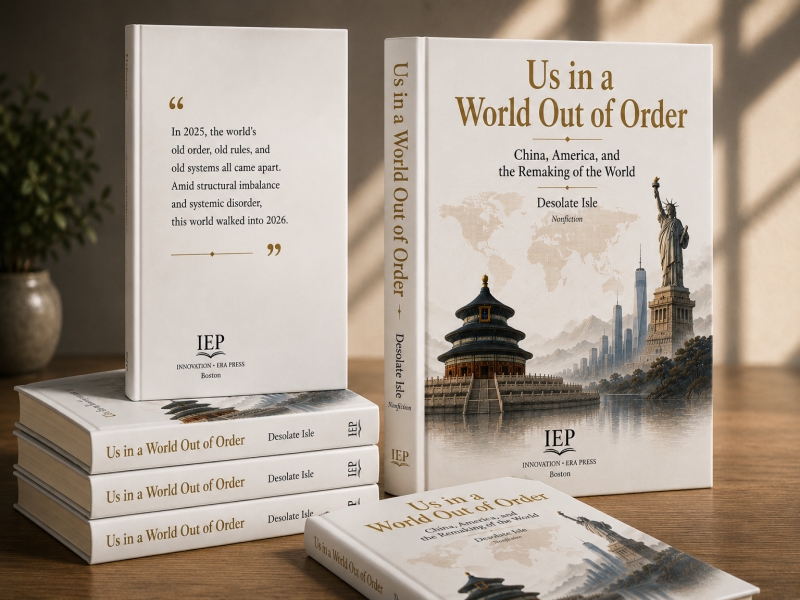
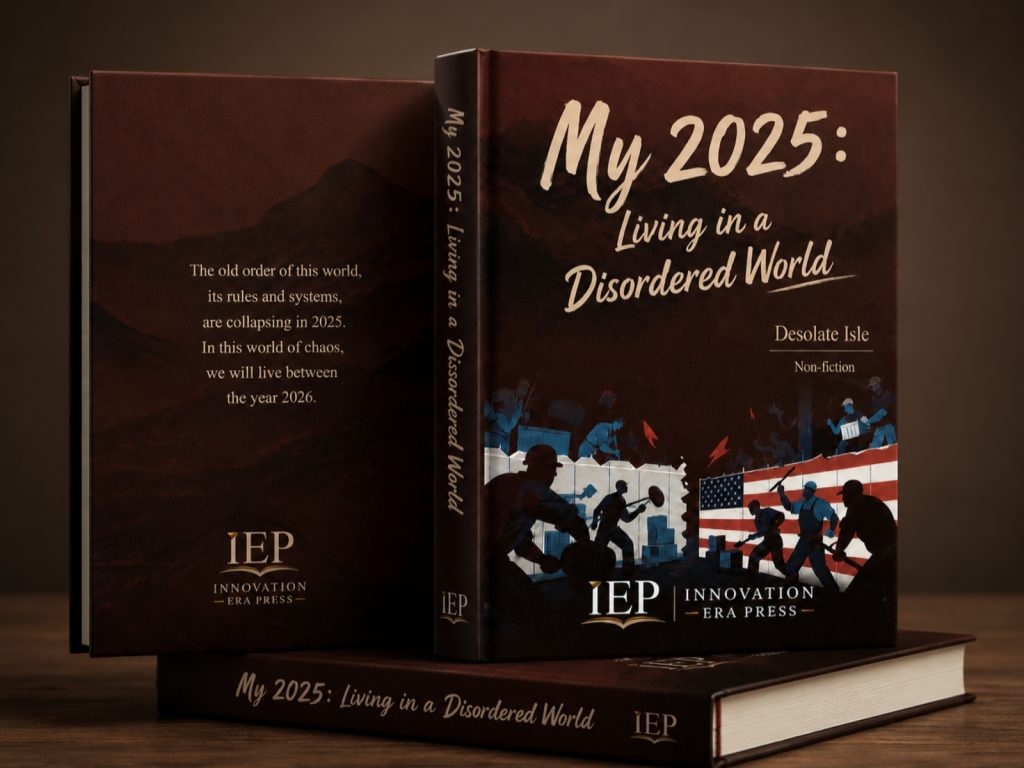
Editions in Simplified Chinese, Traditional Chinese, French, and Spanish will be published and released globally throughout 2026.
There is a genre of literature designed not for escapism, but for confrontation—a mirror reflecting the eras we inhabit, the unspoken anxieties we harbor, and the haunting question of what remains of a person when everything else is stripped away.
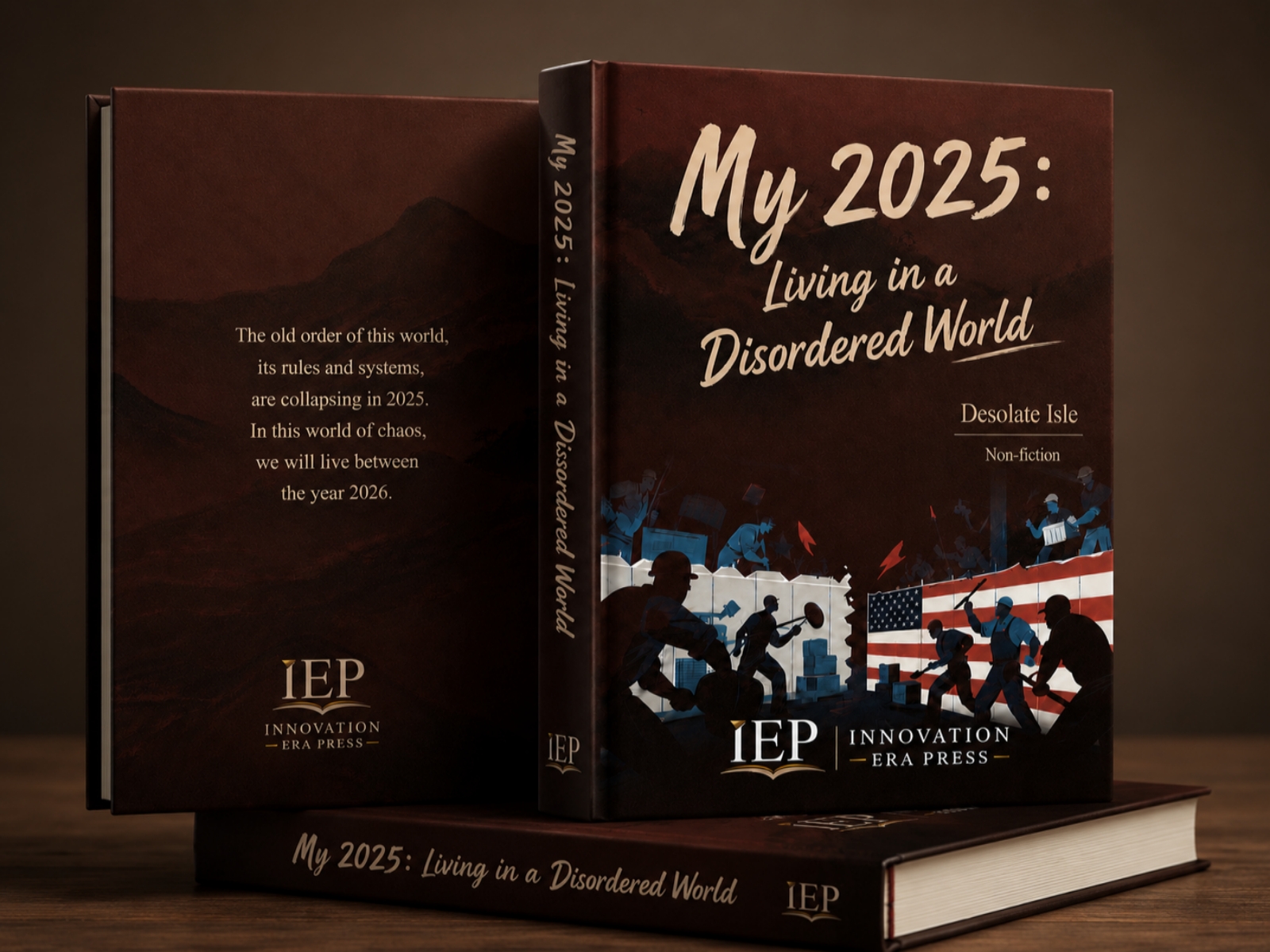
Huang Dao’s My 2025: Living in a Disordered World is precisely that kind of book.
Writing through the intimate lens of the first person, the author chronicles the year 2025—a year on the surface stable, yet churning with undercurrents of a rapidly fracturing global order. Beneath the narrative lies a seismic collapse: unresolved international conflicts, the violent restructuring of the global economy, and the quiet, inexorable reshaping of individual destinies.
The book begins in a claustrophobic, eight-square-meter flophouse in Los Angeles and expands across 15 countries and regions, including the United States, China, Southeast Asia, Canada, and Japan. Along the way, the author encounters and dialogues with nearly 70 individuals: undocumented immigrants, blue-collar laborers, entrepreneurs, academics, Vietnam War veterans, and government officials. My 2025 seamlessly weaves cold, analytical observations of capital and labor structures with profound reflections on the global political climate. Yet, its beating heart lies in the struggles, hesitations, and resistance of those at the bottom of the social ladder—vivid portraits of lives swept up by historical currents, fighting desperately for a foothold.
This is the record of a former “idealist, mission-driven activist” navigating the accelerated tremors of the global order in 2025. Standing amidst the ruins of a completely shattered identity, the author uses writing as an anchor to reclaim his position as a human being.
This is not a self-help manual, an exhibition of trauma, or a cheap narrative of resilience. It is a diagnosis of our time, and a prolonged, clear-eyed spiritual breakout.
I. From “Person of Consequence” to a System Serial Number: The Arc of a Fall
The deepest tension in the book stems from a jarring, discomfiting displacement of identity.
In the opening chapters, we see a man who deliberately changes into a crisp white shirt at an immigration checkpoint to maintain the dignity of a “business traveler.” He is someone accustomed to meticulously reviewing R&D proposals and observing the survival logic of ride-share drivers from the detached, elevated perspective of a leader. This is the habitual posture of the elite—observing the world from a safe, analytical distance.
Yet, as the narrative progresses, this veneer of respectability is stripped away piece by piece.
In the foul-smelling subway stations of Mexico City, during a heart-stopping race against the clock at a midnight border crossing, and finally, huddled inside a plastic detention cell shorter than a man’s height—his shoelaces and belt confiscated—the identity of the “civilized observer” utterly collapses. All that remains is a physical body in a raw, desperate struggle for survival.
The author records this descent—from property owner to the dispossessed, from a named individual to a mere serial number in a database—with an eerie, clinical detachment. It is precisely this restraint that delivers a blow more powerful than any hysterical accusation. The climax of this erasure occurs at a national border entry: because of a single historical data point in a backend database, a respected international professional is instantly transformed by an algorithm into a legally defined “Arriving Alien.”
This single moment exposes the coldest truth of the digital age: the system does not need to understand you; it only needs to classify you. You are no longer “you”; you are a risk label to be processed.
But the significance of this identity collapse extends far beyond the author himself. It symbolizes the collective predicament of an entire generation of middle-class professionals and private entrepreneurs in China. They once believed in hard work, innovation, and institutional rules, only to discover amidst global upheavals that decades of personal accumulation can be instantly erased by a sudden policy shift, a deteriorating geopolitical climate, or a red flag in a computer system.
By deliberately presenting himself not as a hero, but as a case study, the author uncovers the true historical value of this work.
II. The Grinding Machine of Procedure: Structural Cruelty Beneath Civilized Veneers
If the collapse of identity is a personal tragedy, the book’s dissection of “due process” is its sharpest institutional critique.
The six-hour interrogation detailed in the book is an suffocating sequence. The interrogator is not seeking to clarify facts, but rather to construct a pre-baked narrative of a “subversive.” Group photos, ideological walls, and bank statements are all warped through a geopolitical lens into suspicious evidence of “political backgrounds, ideological infiltration, and money laundering.” The interrogation room ceases to be a hall of justice; it becomes a hunting ground of severe information asymmetry. Here, the author poses a piercing proposition: When prejudice precedes inquiry, all honesty becomes a shackle of self-incrimination.
The prison’s “foil-lined holding cells” present one layer of physical coldness, but the true psychological freeze comes from a bail hearing that amounts to nothing more than institutional theater. The government prosecutor, fully aware that the judge lacks jurisdiction, goes through the motions anyway. Confronted by this bureaucratic farce, the author makes the most decisive choice in the book: “I concede. I just want what is mine.”
This line is not merely a dramatic highlight; it represents a rare, lucid realization. When an established order ceases to offer justice, voluntary capitulation becomes the only way to seize back one’s agency.
In a twist of supreme irony, another country—a core member of the “Five Eyes” intelligence alliance—reviewed the neighbor’s “blacklisted data” and issued the author a visa three months later. This casual detail serves as the book’s most damning rebuttal: if even a state’s closest ally disregards its “hegemonic security classifications,” then what was the 22-day detention truly protecting? Security, or was it merely eroding human dignity?
The author offers no angry answers; he simply lays out the facts, leaving the reader to sit with the implication.
III. A Floating World of Souls: Faces in the Fractures of an Era
What makes My 2025 truly moving is not just the author’s personal plight, but how his journey serves as a prism reflecting the fates of countless others.
“Old Ye” from Liaoning is the book’s most vibrant secondary character. Armed with a gritty, earth-toned street smarts, he deconstructs the immigration system’s inner workings, viewing detention as a rite of passage for social mobility. He coins a grimly humorous philosophy: “Every minute in prison is a minute making money.” His worldview stands in stark contrast to the author’s elite background. These two vastly different survival logics meet strangely within the walls of a mass detention facility, piecing together a raw, multi-dimensional mosaic of contemporary China’s marginalized souls.
Then there is “Old Yang,” ruined by the P2P lending crashes, whose midnight awakenings and frantic scratching of his scalp serve as a silent literary footnote to the phrase: “A single speck of dust from an era can crush an individual like a mountain.” We meet a middle-aged woman from Zibo offering massage services in Singapore to survive; and three young Chinese strangers on a Vietnamese beach—a software engineer, a finance professional, and an engineering contractor—all sharing the exact same fate: debris thrown off the tracks after the sudden braking of globalization. In the subdivided “pigeonhole” apartments of Hong Kong, young people cram themselves into four-square-meter spaces, bearing the full, suffocating weight of a generational housing bubble.
The most psychologically complex figure is the “Lady from Chongqing” living in Pattaya, Thailand. She possesses a sharp, cynical clarity regarding the cutthroat nature of domestic business culture, yet remains deeply intoxicated by the grand narrative of a rising superpower, seeking spiritual solace in illusions of resisting “hegemonic conspiracies.” She is simultaneously an enlightened observer and an ideological prisoner, embodying the deepest tragedy of modern society: when a person’s cognition is systemically engineered, they cannot attain true freedom, even when physically abroad.
In their home country, these individuals would likely never have crossed paths. In this book, however, they converge into a cross-class anthology of an era. The author does not judge them from a moral high ground; he views them as fellow travelers slipping through the same historical fractures. This profound empathy forms the emotional bedrock of the book.
IV. The Academic’s Gaze: Institutional Pathology and the Century-Long Cycle
As a technical expert and social observer, the author dissects institutional logic with an incisive professionalism that cuts straight to the structural pathologies of society.
His depiction of the bureaucracy within the “Nanji Group” is ruthlessly precise. These are “test-taking experts” holding PhDs who view “accountability avoidance” as the supreme law of survival. Devoid of passion for innovation, their sole response to systemic errors is to shift the blame onto the most vulnerable. “The teachers didn’t teach it all, the students didn’t learn it right, and the cheaters copied it wrong”—this summary of a derivative, “copycat” management culture is as concise as it is scathing. The physical space known as the “Bagen Grass Compound” becomes a heavy metaphor: an environment that rejects refinement, aesthetics, and responsibility can only cultivate a cheap, barren wasteland.
When the narrative shifts to Jimbocho in Tokyo, the author suddenly stretches his historical horizon back a century. This was the neighborhood where Sun Yat-sen, Lu Xun, and Chen Yinke once gathered to absorb the seeds of democracy and science in hopes of reshaping China. A hundred years later, on the very same streets, organizers of a Chinese book club discuss how to dodge critical questions from readers and package “intellectual idealism” into a lucrative business. The author deeply feels the historical loneliness of Wang Guowei—the scholar who drowned himself in despair because his acute pain could find no resonance. Like the intellectuals of a century ago, the author roams the global map, searching for a place where his soul can finally rest.
This sense of a century-long cycle gives the book a historical weight that transcends personal misfortune. It reminds the reader that this is not an isolated predicament, but a recurring historical fate that visits clear-eyed Chinese intellectuals across generations in strikingly similar guises.
V. Spiritual Arrival: From Dissector to the Awakened
The most beautiful turning point in the book is not a legal exoneration, but an internal reconciliation that takes place on a mountaintop in Da Lat, Vietnam.
Up to this point, the author has maintained the role of a cold, perhaps slightly resentful, observer and forensic dissector of reality. But when confronted with a Vietnamese girl in a white áo dài, the defenseless fish swimming in Xuan Huong Lake, and the realities of a war “selectively forgotten” by history, his scalpel stops. In its place, he picks up a poet’s pen. His poem, The Remnant Glow to the Moon, marks a profound shift in consciousness—from a former corporate boss obsessed with losses, social status, and success, to a man capable of feeling how “the floating dust and the ambient light scatter peacefully together.”
The final chapter closes in a quiet corner of Japan. The transition from a standard visa to an artist visa is more than a bureaucratic milestone; it is a philosophical homecoming. By choosing to converse with the past, cultivate the future, and honor the unwritten codes of civilization through small, deliberate daily actions, the author finds his footing. In a disordered world, this is his chosen path of “ordered survival.”
This spiritual arc provides the book with its ultimate literary cohesion. It evolves from an angry indictment into an intimate psychological history of how a person, stripped of every external label by the tides of history, reconstructs the answer to the question: Who am I?
Conclusion: Honesty is the Rarest Posture in Contemporary Writing
The contemporary discourse is saturated with raw emotion, but utterly starved of honesty.
The rarest virtue of My 2025 is its refusal to compromise on the truth. There are no cheap formulas for success, no simplistic postures of nationalism or rebellion, and no attempts by the author to cast himself as a savior. Instead, he simply throws himself into the historical current and allows the reader to watch: how a person is pushed by forces beyond his control, how he loses his bearings, how he falls, and how—solely through the acts of recording and thinking—he painstakingly restores order to his inner world.
The prose is unpretentious and restrained, almost entirely devoid of superfluous adjectives, giving the narrative the weight and texture of primary historical source material. It documents not just one man’s fall and reconstruction, but the cold imprints left by an era onto the bodies of countless ordinary people—the Xiao Caos, Old Yes, and Old Yangs of the world—who may otherwise never have a voice.
Years from now, when people look back at this volatile decade, this book may well stand as a vital text for understanding the destiny of the Chinese diaspora, the fractures of the global order, and the spiritual drifting of the individual in the 2020s.
It will endure not because of the sheer volume of suffering it portrays, but because it preserves something that is rapidly vanishing: a scholar’s fierce sense of responsibility toward the truth in a disordered world, and an obstinate refusal to completely lose his soul.