By Desolate Isle
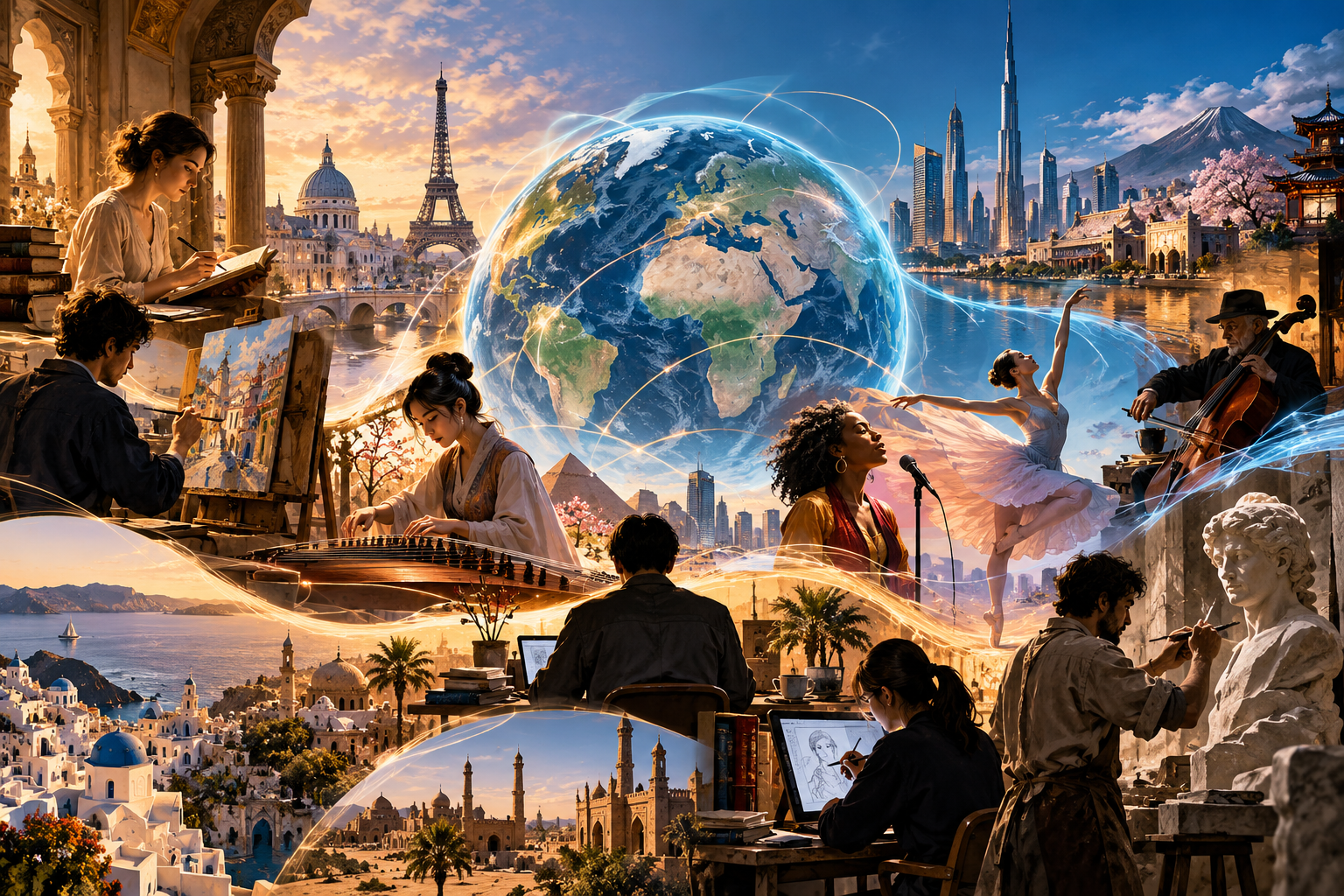
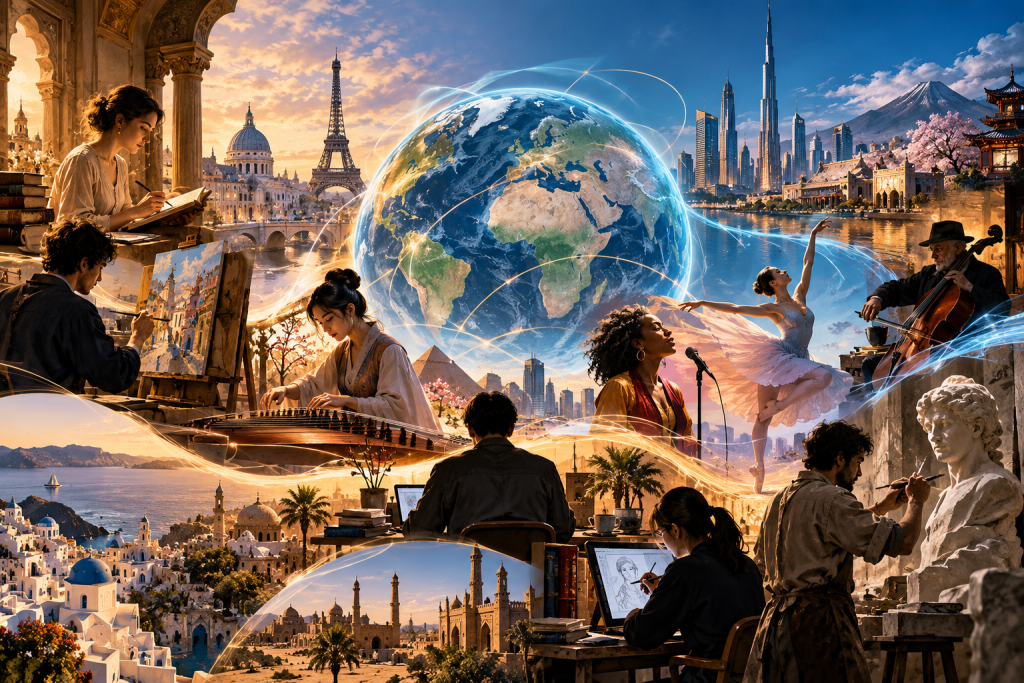
Almost every life that comes into the world arrives with some gift. Some can sing, some can dance; some can draw anything to the life, some overflow with fanciful ideas, and some have a keen intuition for mathematics and science. This is what we call talent and passion — or, as the Tang poet Li Bai put it, “Heaven gave me talents, and they must have their use.” Since ancient times, language, music, dance, painting, and performance have been the ways human beings communicate, express themselves, and live, handed down from generation to generation. The humanities and the arts have always answered a spiritual need beyond material needs. They are indispensable, and together with material wealth they are the treasures of civilization.
Yet unlike material things, which have a natural existence of their own, the humanities and the arts, though drawn from the whole wide world, tend to distill its essence best when creation is free. In a confined social environment, by contrast, they lose their diversity: more and more works turn out uniform, all but standardized and prescribed, until audiences grow weary and their eyes and ears go numb. When supply falters, demand withers too; each holds the other back, and a vicious circle sets in.
This vicious circle has recurred again and again throughout Chinese history: the burning of books and burying of scholars, the suppression of the Hundred Schools of Thought, the eight-legged essay examinations, the banning and destruction of private academies, the imperial examination as the only path, the literary inquisitions, the campaigns against “revisionism”… Dynasty after dynasty, it has been all too common. Even in today’s globalized world, some writers, journalists, and painters, seeking greater creative freedom and freer forms of expression, have had no choice but to leave their homeland and settle abroad.
On the other hand, the developed world has not shut its doors to talent. In recent years, immigration policies across Europe, the United Kingdom, the United States, Australia, and Japan have generally tightened. But since the Second World War, their pathways for artistic, scientific, and skilled talent have largely remained open, broadly so even when right-wing or far-right parties are in power. What has been tightened or closed is mainly the route for large numbers of ordinary investor immigrants and immigrants without specialized skills.
A brief professional note here: in European and American usage, literature and art are distinct creative fields. But in copyright, cultural policy, social security, and some immigration systems, literary creation is usually included in a broad category of artistic and cultural work, so a writer can hold the legal or administrative status of an “artist.” By common sense, then, writers and artists should be among the groups most able to globalize their “identity.”
True globalization is the globalization of people — the globalization of a person’s “identity”: being able to live wherever one wishes. For people from developed countries, there is almost no barrier to this. And their “doors,” in a sense, are also open to people from developing and least developed countries, among whom writers and artists form a distinctive group of beneficiaries. This shows not only in immigration policy but also in dedicated programs of welcome. France’s PAUSE program (the national program for the emergency reception of scientists and artists in exile), led by the Collège de France with participating institutions such as the École des hautes études en sciences sociales (EHESS), takes in scholars and artists forced to leave their countries. The International Cities of Refuge Network (ICORN), headquartered in Norway, offers residencies to persecuted writers and artists. From Milan Kundera to Joseph Brodsky, from the Chinese-born French writer Gao Xingjian to the artist Ai Weiwei, all found soil abroad in which to keep creating — and Brodsky and Gao Xingjian each went on to win the Nobel Prize in Literature.
At the same time, however, a new phenomenon has emerged: Chinese-language writers and artists find it very hard, sometimes impossible, to obtain an international “identity”; they are often stopped at the visa stage. The door is open — so why can’t they walk through it?
How can Chinese-language writers and artists come close to, or meet, the requirements for talent visas in Europe, the UK, the US, Australia, and Japan, and enjoy the advantages of an international “identity”? It is a question I am often asked in founding Innovation Era Press and establishing the International Academy for Talent Discovery and Development. Drawing on the experience of successful artist (literary) visa applications in several countries, I can tell you plainly: it has almost nothing to do with your degrees, professional titles, assets, or money. It depends on whether your work has left a verifiable footprint on the international stage. And the starting point of it all is taking the first step toward international creation: just as you once wrote your first essay, painted your first picture, sang your first song, or danced your first dance in Chinese, you must now let your work travel and be shown in English, French, Spanish, and other European and American languages.
With AI translation and editing growing more capable every day, there is no need to wait and see. Revise your Chinese draft, put it into a clean, standard format for AI translation, then refine the result by hand, and it can be done. Of course, you can and must remain the original creator. Translated and edited with AI, the work is still your original work; but it must stand up to originality checks, and you should state honestly how it was translated. That is a matter of integrity, and also a way of protecting your work.
Your original work, presented in a European or American language, circulates in the developed world; it obtains copyright registration; it is submitted for awards or exhibitions; it enters academic exchange; it receives reviews or is collected; it earns ongoing royalties or income; it gradually builds a readership and an audience… All of this means that you and your work are already on the road of international creation. Each step gathers evidence for the next, and brings you one step closer to the goal you want to reach.
“Heaven gave me talents, and they must have their use” — and that use has never been confined to a single language. The globalization of “identity,” in the end, is not about a different country’s name on your passport; it is about your name and your work being recognized, and remembered, in another language. For a creator, the work always sets out first, and the person arrives after.
Chinese literature and art have achieved glory in the world and continue to advance, but their future should not live in one language alone. Every Chinese work that goes out into the world, and every Chinese-language creator who globalizes their “identity,” is a grain of sand in the tower that Chinese creation is building, grain by grain, in the world.
If you are a writer, painter, musician, or dancer working in Chinese, why not start one thing today: choose the work you are proudest of, and give it its first version in another language. The door has always been open; all that is missing is your work on the other side of it. Helping more Chinese-language creators take that step is exactly why I founded Innovation Era Press and am establishing the International Academy for Talent Discovery and Development.