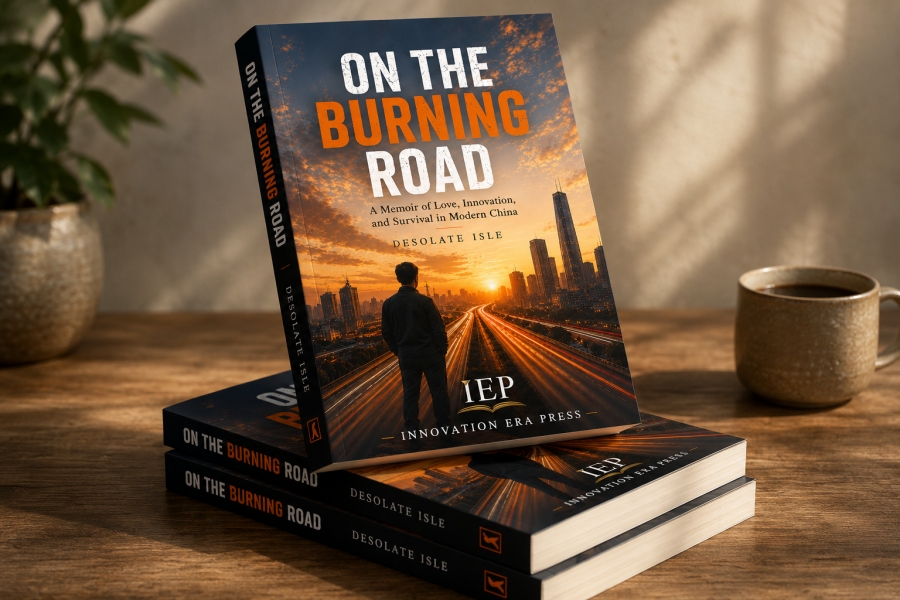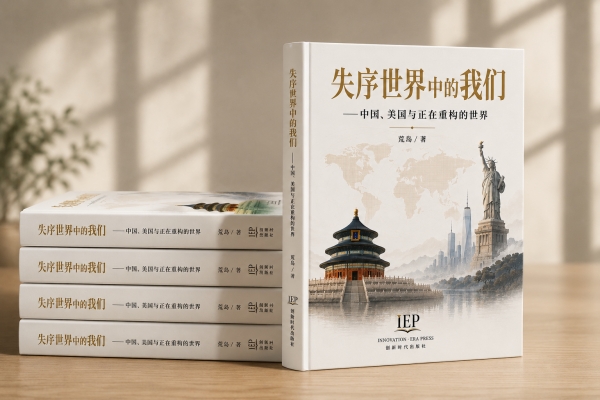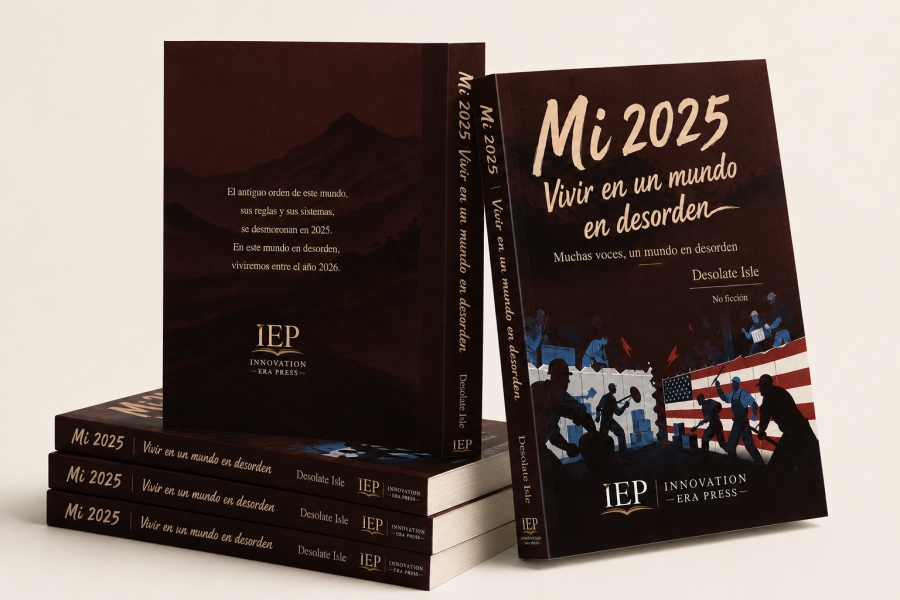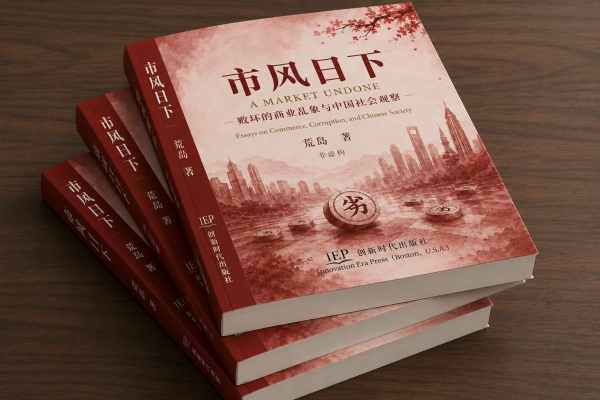
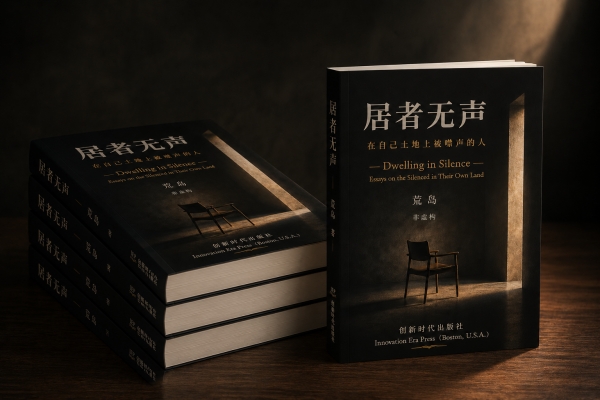
Innovative Era Publishers (IEP, USA) announced today that Dwelling in Silence: Essays on the Silenced in Their Own Land, a Chinese non-fiction work by the author Desolate Isle, is officially released worldwide today, June 17. The book is now available to readers globally in both e-book and print formats.
- Library of Congress Control Number (LCCN): 2026944556
- E-book ISBN: 9798950761034 Buy Now
- Available now on major global platforms.

Author’s Preface: The Silenced Chinese
May 24, 2026
The six years spanning 2020 to 2025 were an extraordinary period during which many Chinese people endured trials akin to a life-and-death ordeal. Businesses collapsed, families went bankrupt, and some even took their own lives—lives that should not have ended so soon. Misfortunes never come singly: first came the economic downturn, followed by pandemic lockdowns, and then the rampant culture of neijuan (involution). Consequently, real estate prices—which almost all Chinese people had expected to rise and had speculated on for nearly twenty years—plummeted. Various measures deployed by governments at all levels failed to yield results; instead, the movable and immovable assets of countless families and enterprises fell rapidly alongside housing prices.
Talking too much with others runs the risk of being labeled a “chatterbox.” Therefore, under the dual immense pressures of a deteriorating economic environment and a corporate operational crisis, I turned to writing as an outlet to relieve my anxiety—a disguised way of engaging in a dialogue with society. Over these six years, I wrote more than 400 original articles on the “Innovation Academy” WeChat official account. This was despite the fact that having my articles rejected, deleted, or my account suspended due to content being mysteriously deemed “in violation of regulations” had long become a routine occurrence.
Dwelling in Silence compiles 131 articles written during these six years, covering topics such as the pandemic, real estate, people’s livelihoods, and US-China relations. The book is divided into four sections:
- Epidemic & Prevention (疫·防)
- Housing & Bondage (房·役)
- News & Inquiries (闻·问)
- West & East (西·东)
Concurrently published and released are A Market Undone (on business and economy) and Borrowed Light (a collection of literary essays).
As an author accustomed to writing social commentary and non-fiction, I have always maintained that the voice one puts forth must be grounded in facts. The fabricated words, data, images, and voices widely staged in society—whether born out of certain political needs or appearing endlessly entertaining—will ultimately harm the innocent and fail to withstand the retrospective gaze of history. Compiling these articles into a published book removes the uncertainty of self-media accounts and articles whose survival is always precarious, allowing them to be preserved in a more permanent historical record.
When applying for an LCCN from the Library of Congress, the system required an English title. Thus, I translated Ju Zhe Wu Sheng (居者无声) as Dwelling in Silence: Essays on the Silenced in Their Own Land. As the content of this book demonstrates: those who were confined during pandemic prevention, those who were enslaved by home buying, those who were silenced in daily life, those who were trapped in making a living, and those who were consumed by hard labor—the vast majority of them are precisely the insignificant, those whose voices carry no weight.
I shared this book with the AI Claude and asked it to recommend five representative pieces. It selected:
- What Exactly Caused the Massive Unemployment?
- Why Didn’t Ancient Officials Dare to Report Bad News?
- Cao Keming: A Rare Good Official for the People of Nanjing Back Then
- If You Are Not the Same Kind of People, Truly Do Not Enter Marriage
- No Matter How Many Miracles of Bridges and Tunnels, They Cannot Compare to Letting People in the Dark See the Light
Claude noted that these five pieces span five dimensions—society, politics, history, human nature, and civilization—and represent the diverse writing styles found throughout the book. I suggest that readers review the entire content systematically; of course, you can also pick and choose what to read, as each article stands independently. Invariably, there will be one that connects deeply with the life or work of any given reader.
I know that not every Chinese person is willing to be silent. Amid pain, hardship, and even despair, there are too many people who want to speak but have nowhere to do so, who want to cry out but have no one to listen. I hope this book can speak for those who are forced into silence, allowing more people to hear our collective voice.