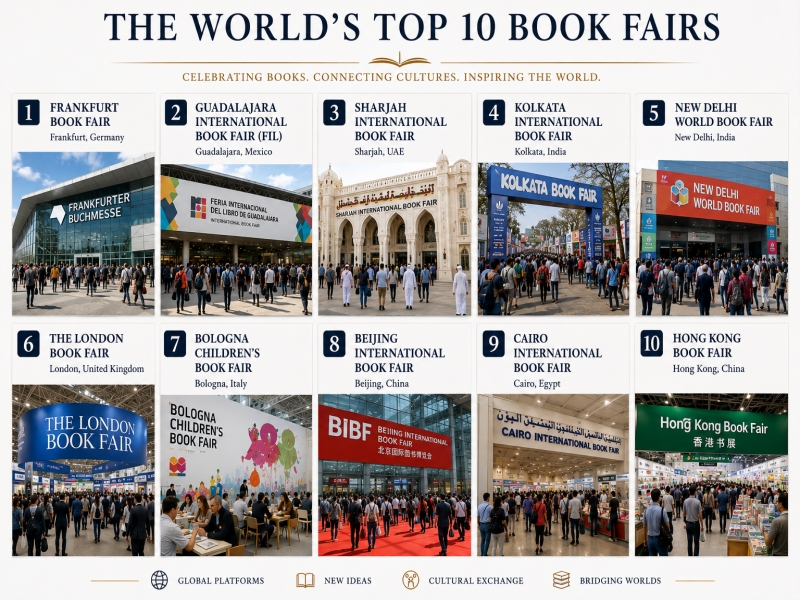
Every year, the map of global publishing lights up city by city in turn. From the rights-negotiation tables of Frankfurt to the open-air sea of books in Kolkata where two million people surge through, a book fair has long since ceased to be merely “a place to sell books”—it is at once a marketplace where publishers buy and sell rights and negotiate translation licenses, and a cultural festival where ordinary readers meet authors face to face and queue up for a single book.
It must first be said that the “scale” of a book fair is measured by two different yardsticks. One looks at the number of exhibitors and the volume of rights trading—this is the industry-facing “trade fair.” The other looks at visitor numbers—this is the public-facing “retail fair.” The rankings these two yardsticks produce are utterly different: Frankfurt sits firmly at the top by industry influence, while Kolkata claims the crown by sheer foot traffic. The list below takes both into account, and identifies the core character of each fair in turn.
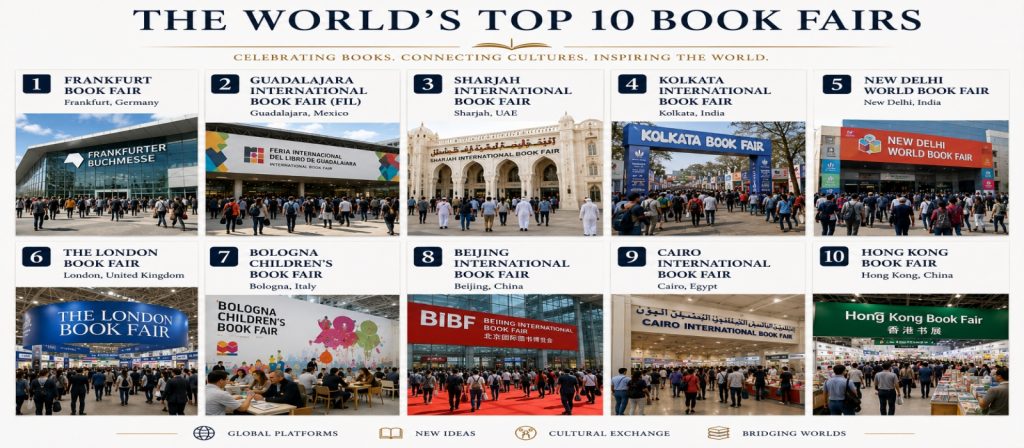
I. Frankfurt Book Fair (Germany)
The acknowledged “world’s number one book fair,” and the annual headquarters of the global publishing industry.
Dates and venue: Each October, at the Frankfurt Trade Fair grounds in Germany; a five-day run.
Organizer: Frankfurter Buchmesse GmbH (a subsidiary of the German Publishers and Booksellers Association).
Core character: A purely industry trade fair.
Its history can be traced back to the early days of Gutenberg’s printing press in the fifteenth century. Year after year it draws around 7,000 exhibitors from over a hundred countries and more than 200,000 visitors. The first few days are open only to professionals; the public is admitted only on the final two. This is the bellwether for global rights trading, translation licensing, and publishing trends, and its annual “Guest of Honour” program is an important springboard for the literatures of various nations to reach the world. For a publisher, “having been to Frankfurt” is almost a badge of professional identity.
II. Guadalajara International Book Fair (Mexico, FIL)
The largest book fair in the Americas, and the publishing center of the Spanish-speaking world.
Dates and venue: From late November to early December each year, in Guadalajara, Mexico; a run of about nine days.
Organizer: The University of Guadalajara.
Core character: Industry and public in equal measure.
Since its founding in 1987, FIL has both provided the Spanish-language publishing world with a top-tier environment for commercial negotiation and opened its doors to hundreds of thousands of ordinary readers, letting them encounter authors and discover new books. It is the most important publishing event in Ibero-America, carrying the dual identity of a rights-trading hub and a festival of reading for all, drawing more than 800,000 visitors each year.
III. Sharjah International Book Fair (United Arab Emirates)
A Middle Eastern giant that has risen sharply over the past decade, ranking first in the world in rights-trading volume for several consecutive years.
Dates and venue: Each November, at the Expo Centre Sharjah; a run of about eleven to twelve days.
Organizer: The Sharjah Book Authority.
Core character: A rare combination of enormous foot traffic and top-tier industry trading.
On one hand it draws more than 1.8 million members of the public and gathers over two thousand publishing houses from upward of a hundred countries; on the other, it holds a three-day Publishers Conference before the fair, facilitating more than three thousand rights-matchmaking meetings in just two days. Backed by a generous translation grant fund, Sharjah has become a key rights-trading center for the “overlooked markets” of Africa, Asia, and the Middle East, and another crucial autumn trading venue following Frankfurt.
IV. International Kolkata Book Fair (India)
Measured by attendance, this is the largest book fair in the world, and the largest “non-trade” book fair anywhere.
Dates and venue: Usually from late January to early February, in Kolkata, India; a run of about two weeks.
Organizer: The Publishers & Booksellers Guild of Kolkata.
Core character: A thoroughly public retail fair.
It is aimed at ordinary readers rather than wholesalers, and each edition draws more than two million visitors—the sight of whole families turning out, picnic blankets spread, to “browse the books” is a spectacle in itself. The fair is often held alongside a literary festival, blending book signings, reading groups, and cultural performances into one—a veritable cultural carnival for the city.
V. New Delhi World Book Fair (India)
A core platform for South Asian publishing, and one of the largest book fairs in the English-speaking world.
Dates and venue: Usually at the start of each year (January to February), in New Delhi; a run of about one week.
Organizer: The National Book Trust of India.
Core character: Industry and public in balance.
Founded in 1972, it serves India’s vast publishing ecosystem of nearly ten thousand publishers operating in eighteen languages. It is both a trading platform for domestic and international publishers and an event for a huge local readership, drawing close to two million visitors a year, with students, families, publishers, and writers gathered together.
VI. London Book Fair (United Kingdom)
A rights-trading stronghold of the European spring, second in standing only to Frankfurt.
Dates and venue: Each spring (usually March or April), in London; a three-day run.
Organizer: Reed Exhibitions.
Core character: An industry trade fair.
It grew out of a specialist event originally serving small publishers and librarians, and is now the “spring Mecca” for Europe’s publishing world, rights agents, and media. Though short in duration, it is intensely focused on rights buying and selling, industry forums, and networking—together with Frankfurt in the autumn, it forms one of the two pillars of global publishing’s trading calendar.
VII. Bologna Children’s Book Fair (Italy)
The undisputed number one fair in the world for children’s books and illustration.
Dates and venue: Each spring (usually March or April), in Bologna, Italy; a four-day run.
Organizer: BolognaFiere.
Core character: A highly specialized industry trade fair, focused solely on children’s books.
It is almost entirely closed to the general public, serving instead as the annual gathering point for the world’s children’s-book publishers, illustrators, rights agents, and art directors. Before its famous “Illustrators Wall,” young artists queue to display their portfolios and seek out collaborations. For the children’s-book industry, Bologna is the world center of rights trading and talent discovery.
VIII. Beijing International Book Fair (China)
One of Asia’s most important rights-trading fairs, and a core window for Chinese publishing’s “going global” drive.
Dates and venue: Late summer each year (usually August or September), in Beijing; a run of about five days.
Organizer: China’s national press and publication authorities together with the China National Publications Import & Export (Group) Corporation, among others.
Core character: Primarily industry trade, with some public participation.
It is the main stage on which Chinese publishing connects with the world, drawing more than 300,000 visitors a year and focusing on the import and export of rights and on international co-publishing. For publishers hoping to enter the Chinese-language market, or to bring Chinese works to the world, Beijing is an unavoidable stop.
IX. Cairo International Book Fair (Egypt)
One of the oldest and most popular book fairs in the Arab world.
Dates and venue: Usually from late January into February, in Cairo; a run of about two weeks.
Organizer: The General Egyptian Book Organization.
Core character: A mass-public fair, primarily retail.
Founded in 1969, it is the oldest book fair in the Arab world, drawing one to two million visitors each year and occupying a central place in the region’s literary dissemination and public cultural life. Affordable book prices and surging crowds are its defining hallmarks.
X. Hong Kong Book Fair (Hong Kong, China)
One of Asia’s most popular city book fairs, and a window where Chinese-language publishing meets world literature.
Dates and venue: Mid-July each year, at the Hong Kong Convention and Exhibition Centre; a seven-day run.
Organizer: The Hong Kong Trade Development Council.
Core character: Primarily public-facing retail and cultural programming.
Since its first edition in 1990, the Hong Kong Book Fair has grown year by year, with each edition’s attendance approaching one million. It both sells books in Chinese and from around the world and hosts dozens of talks by celebrated authors and cultural forums, while linking up with the concurrent Sports and Leisure Expo and World of Snacks to become an iconic cultural-tourism IP of Hong Kong’s high summer.
A Further Observation: Why Is the United States Absent from the List?
Reading this far, the attentive reader may notice something unexpected: as one of the largest publishing markets in the world, the United States has not a single book fair that makes this list. This is no oversight, but a consequence of the very structure of the American book industry.
In fact, the United States once had a major national book trade fair—BookExpo America (BEA), long the most important industry event in the country. But it was permanently discontinued by its organizer in 2020. Since then, the United States has had no domestic rights-trading fair on the order of Frankfurt or London.
The deeper reason is that the United States has split “industry trading” and “public engagement” apart, and has concentrated neither into a single mega-event. On the rights-trading side, American publishers are more accustomed to “going abroad”—flying to Frankfurt, London, or Bologna to negotiate rights and translation licenses, or operating year-round through a highly developed system of literary agents, without relying on a major domestic fair. On the public side, the United States follows a path of locally dispersed book fairs and literary festivals: the Los Angeles Times Festival of Books, the largest public book festival in the country, draws about 150,000 visitors a year—an impressive figure, but nowhere near the order of Kolkata’s two million or Hong Kong’s near-million. The Miami Book Fair, the Texas Book Festival, and others are likewise excellent regional events, yet each is scattered and limited in scale.
It is worth noting that the largest book-related professional event in the United States is in fact the American Library Association Annual Conference (ALA Annual). But it is, in essence, a flagship gathering of the library world, centered on library acquisitions and the work of libraries rather than on retail book sales or rights trading to the general public, and so it is not usually classified as a “book fair.” Its host city also changes each year, rotating among major American cities—the 2026 edition, marking the ALA’s 150th anniversary, is held in Chicago.
A more accurate way to put it, then, is this: the United States is not without the fragrance of books, but its book culture is highly “distributed”—no single city, no single event, can concentrate the nation’s foot traffic and trading into a volume sufficient to rank among the world’s top ten.
In Closing: Two Kinds of “Big,” Two Kinds of Meaning
Surveying these ten great book fairs, it is not hard to see that they in fact belong to two different worlds.
One kind is the industry fair that stands on rights trading—Frankfurt, London, Bologna, Beijing—whose value lies not in how many books are sold, but in how many rights and translation deals are struck. These are the true engines of publishing’s global circulation.
The other kind is the public fair that wins by foot traffic—Kolkata, Cairo, Hong Kong—which turns reading into a collective festival for a city, letting ordinary readers, suitcases in hand and children in tow, savor the simplest pleasure of buying books amid a sea of them.
And fairs like Guadalajara, Sharjah, and New Delhi deftly straddle both, serving at once as marketplaces for the industry and carnivals for the public.
To understand these two kinds of “big” is to understand the dual life of the book fair: it serves the commercial bloodstream of the publishing industry, even as it safeguards that most ancient of encounters—the one between an ordinary person and a book.