
By Desolate Isle
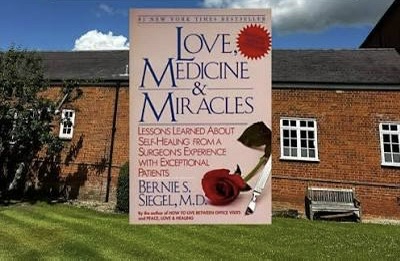
In 1986, the American surgeon and mind-body medicine advocate Bernie Siegel wrote in his bestselling book Love, Medicine and Miracles: Lessons Learned about Self-Healing from a Surgeon’s Experience with Exceptional Patients:
“There are no incurable diseases, only incurable people.”
Elsewhere in the book he puts it even more plainly: “The truth is: love heals.” Illness, as Siegel saw it, cannot be separated from our state of mind, and love is not a particular course of treatment but a healing force in its own right.
When I read those words, something struck me and set me thinking. One thing is certain: death is part of life’s program, and within that program there is, strictly speaking, no such thing as disease. The bodily disorders that precede death, even when we call them diseases, are merely the dying process within the program of death. Even an illness that is cured, followed by decades more of life, remains one step on life’s road toward death.
It is equally clear, however, that over the course of a lifetime there is another kind of disease, one that lies outside the dying process: disease brought on by trauma, by anxiety, or by both. It, too, can kill, but it is not part of the natural, law-governed process of dying.

If “love heals,” and if this kind of disease is not part of the dying process, then who is the real culprit behind it? I cannot help thinking of the man-made bond so closely tied to romantic love: marriage. Let me be clear: I am not against marriage. The question mark in the title means it presumes no position; I simply want to talk about phenomena and facts.
Romantic love is not the whole of love, but it can stand for love, because it is love in its most concentrated and ardent form. It springs, on the one hand, from the primal attraction between the sexes, and on the other, from the genetic symbiosis we share as living creatures. Romantic love, then, is born of longing and goodness. Once two people feel longing and goodness toward each other, they are all but destined to fall in love, and then to resonate, to live as one, and to bring forth what people call a new life force.
Romantic love, therefore, is innate and exclusive. Every person will fall in love with at least one other person in a lifetime; love’s arrival is never blocked by worldly possessions. It is universal. If we say that love is missing, what is missing is not its occurrence but the place it deserves in people’s lives, a point I will return to later.
And marriage? If we define marriage as the life two people share, it ought to be the sublimation of love. If we define it as a formal relationship, then one can enter it with or without love. Across thousands of years of recorded human marriage, apart from the rare unions born of love, envied and celebrated in story and song, the vast majority of marriages began with two strangers simply being made husband and wife. We do not rule out that two strangers, once married, may develop shared habits and come to love each other over time. But viewed as a formalized, codified institution, marriage originated in the will of a few and was imposed upon everyone.
Marriage, therefore, is man-made and self-serving. When a few people in agrarian societies first defined and prescribed it, they did so in the name of survival and social order, but in substance to protect their own interests within that order.
Suppose two people, in a society free of any formalized or codified ethical constraint, choose out of love to live together of their own free will; that way of life could be called marriage, or cohabitation, or family. In reality, however, we live in societies governed by codified ethics, so the “free will” of marriage always comes with conditions — countless other conditions, which leave almost no one able to resist doing everything possible to get married. And so our attitude toward marriage often comes down to this: we can live without it, and yet we cannot live without it.
This leads to a judgment about marriage: every attached condition, every stratagem devised to meet it, may amount to an imposed change — altered habits, making do, forcing things, compromise… The anxiety that follows, and the unhealthy habits and behaviors that grow out of it, all become causes of disease. And marriage is unlike any other social relationship: it is lived day and night, year after year, with little chance of escape, so these causes accumulate day upon day. No one can truly and fully satisfy or adapt to such conditions, unless what binds the two is that innate kind of love, free from external constraint.
Crowds of people living alone, crowds living together “without papers,” crowds asking: “What exactly is love, and what is marriage? Should we have love at all, should we believe in it, should we marry?” These questions are becoming a public conversation that cuts across age, class, and race. On one side, almost no one can avoid scrambling toward marriage; on the other, more and more people are living alone, living together unmarried, and asking questions. This is precisely the contradiction of our time. The questions are not entirely new. But in the past they were asked only by a handful of thinkers and rebels; through thousands of years of slave, feudal, and agrarian societies, even those who harbored doubts had no power to overturn the “divine law” of marriage laid down by a few. Only today have these questions become, for the first time, a choice ordinary people can act on. That is why they cannot be dismissed as old clichés; they are new phenomena and new problems.
We must admit that marriage, a universal and long-standing codified ethical institution, has — now that love has been set free — become for the first time an object of widespread debate and questioning. The questioning itself shows that its man-made, self-serving flaws can no longer be concealed by tradition. And it is precisely these flaws that have directly driven countless people into anxiety, and even into illness.
Some will say that marriage makes people healthier and longer-lived. For marriages founded on love, in which two people nourish each other, that may well be true. But this essay is about marriages brought about by conditions rather than by love.
“We can live without it, and yet we cannot live without it”: this contradiction keeps people anxious as they think about marriage, and that anxiety in turn leads them to doubt and interrogate love. Yet love itself, innate and exclusive, should never have been doubted or interrogated. In a sense, it is because love has long been neglected, and even lost, in codified marriages that turn strangers into bedfellows, that we now face this irony: marriage makes people anxious, yet it is love they come to doubt.
Finally, here is what I want this essay to say: love can lead two people into a new life together, but marriage is not a necessity of life. True love can heal every disease outside life’s own program, but it cannot change that program: death. And the marriage entered while wavering between “we can live without it” and “we cannot live without it” — that is the true root cause of human disease.