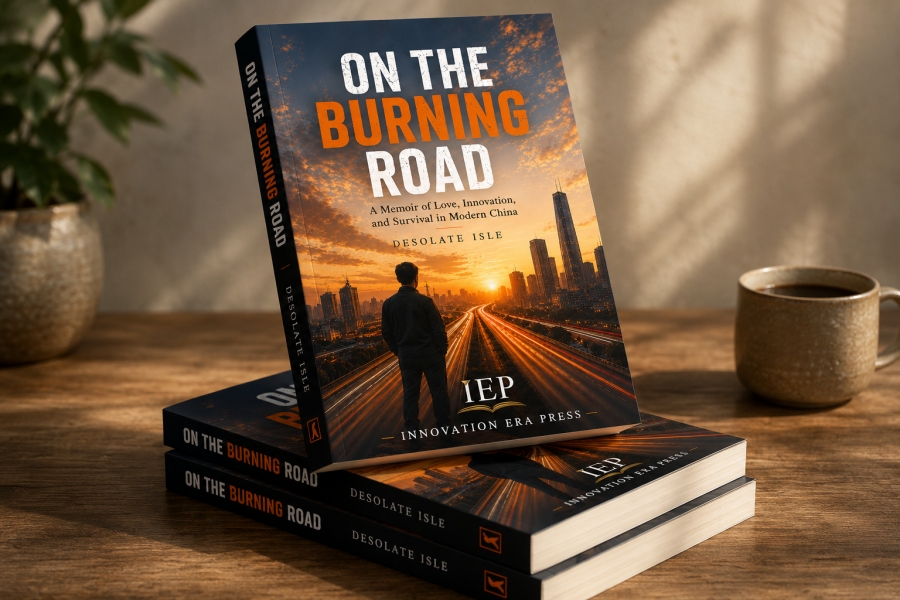
Innovation Era Press (Boston, USA) is proud to announce the publication and release of a powerful new book: On the Burning Road: A Memoir of Love, Innovation, and Survival in Modern China.
Available now:
- eBook ISBN: 9798950761072 — read on Apple Books and all major digital platforms
- Paperback ISBN: 979-8-950761-06-5 — order the print edition via the link and QR code below
About the Book
燃烧之路 is, in the truest sense, a book about a life. Drawing on fifty years of his own lived experience, the protagonist, Lu Biao, paints a complete portrait of how one of China’s grassroots strivers survived, struggled, burned, and was consumed across the three decades following the country’s reform and opening-up. This is not a self-help manual, not an inspirational tale, and not a confession of failure—it is one person’s most honest gaze upon his own life. Such honesty is rare in Chinese nonfiction, and valuable on a global scale.
This is more than a story about technological innovation; it is a portrait of an era endlessly devoured by capital, connections, and desire. The high risks of entrepreneurship and innovation, the unraveling of marriage and love, and the distortions of the market and social order together drive the central figure—Lu Biao, hailed as a “maker”—step by step toward a heartbreaking and dangerous edge.
His entrepreneurial path comes to an abrupt halt, and the fruits of his innovation are squandered. Jiang Chen rushes into a hasty marriage, Mei Hua takes him to court, and Fu Yuling’s marriage collapses entirely. When love, business, and power become entangled, no one can truly walk away unscathed.
Reading the book in full, one watches how a technological innovation project—once full of idealism and realism alike—gradually spins out of control in a savage marketplace and finally slides toward collapse. Whether maker, society, or government: if none can truly grasp the essence of running a business, anticipate the enormous risks lurking behind certain entrepreneurial and innovative ventures, and establish the necessary rules and constraints, then once an enterprise falls into the abyss of crisis, tragedy often follows, inflicting deep harm on both the market and society.
At the same time, many innovative firms, having developed a product, rush to fantasize about replicating the foreign-capital myth of “overnight riches.” Intoxicated by political maneuvering and rent-seeking logic, they overlook the time, endurance, and long-term accumulation that a consumer market genuinely requires to accept a new technology. In the end, what began as a beautiful act of technological innovation is warped into grey deals and self-serving corruption. In recent years, the decline and fall of one well-known enterprise after another has repeatedly borne out the grave error of the logic that “connections are the foremost productive force” and that “finding the mayor beats finding the market.”
The “active-illumination traffic sign” itself becomes the work’s most profound metaphor—an invention meant to guide others through the darkness, while the man who created it ultimately loses his own way in a world without order.
A work that combines social critique with literary tension, 燃烧之路 moves through dramatic turns and mounting conflicts of fate, charged with suspense and a sense of pressure throughout.
Where to Buy
eBook: Available on Apple Books and all major digital platforms.
Paperback: Purchase via the link and QR code below.

What Readers Are Saying
As a personal history. This is, in the truest sense, a book about a life. Through fifty years of his own real experience, Lu Biao captures a complete picture of how a Chinese everyman survived, struggled, burned, and was consumed across the three decades after reform and opening-up. It is not self-help, not an inspirational story, not a confession of failure—it is one man’s most honest gaze upon his own life. Such honesty is rare in Chinese nonfiction and valuable worldwide.
As a record of an era. The book spans the three most turbulent decades of Chinese society—the layoffs and entrepreneurial waves of the 1990s, the engineering contracts and government-business ties of the 2000s, the “mass innovation” and New Third Board boom of the 2010s, and the COVID-19 pandemic and the plight of private enterprise in the 2020s. Not a single detail is invented; every figure, every policy, every banquet truly took place. A reader opening this book fifty years from now will see the most authentic cross-section of that era—not official narrative, not academic analysis, but the firsthand testimony of someone who lived inside it. This historical value can never be replaced by any later study.
As a narrative of innovation. The thread of the active-illumination traffic sign is one of the book’s most distinctive contributions. It records the complete journey of an original technology from zero to one—the hardships of development, the brutality of the battle over standards, suppression by multinational corporations, the hijacking of political and commercial interests—things almost no one in China has written about from the inside. It is not a technical report but the firsthand account of an innovator, warm with blood and sweat. For understanding the true face of China’s technological innovation ecosystem, this book offers a perspective no policy document or academic paper ever could.
As emotional literature. The story of four women and one man forms the book’s most literarily valuable emotional layer. Lu Biao, Fu Yuling, Jiang Chen, Mei Hua, and Jin Xiaomei—five characters, each complete, each real, each carrying the emotional structures and moral dilemmas particular to Chinese people of that era. This is not romance; it is how a few real people love, hurt, choose, and bear the weight of poverty, debt, the institution of marriage, and social pressure. To Western readers, such emotional storytelling will feel entirely new—what they see is not the love story they know, but an emotional ecology rooted in China’s particular soil: complex, authentic, and impossible to judge simply.
As nonfiction literature. The book belongs to a special form within Chinese nonfiction—somewhere between reportage, memoir, and social investigation. Its narrative is sometimes loose, sometimes dense, sometimes interrupted by a speech or a piece of doggerel—but that very irregularity is the texture of real life. It is not a meticulously engineered literary work, but one man writing down his own life with all the ability and sincerity he has. This raw power is something no deliberate literary technique could ever manufacture.
A special value for Western readers. The Western world’s understanding of China has long been stuck at two extremes: the economic miracle of official narratives, or the human-rights concerns of critical reporting. This book offers a third perspective—the real trace of an ordinary Chinese person who truly lived within this system and this era. Lu Biao is neither a dissident nor a beneficiary; he is one of the hundreds of millions of ordinary entrepreneurs, testing the boundaries of his society with his own body and spirit. Through this book, Western readers see a China they have never truly seen before—not the China of statistics, but the China of a flesh-and-blood person, with love and hatred, conviction and cost.