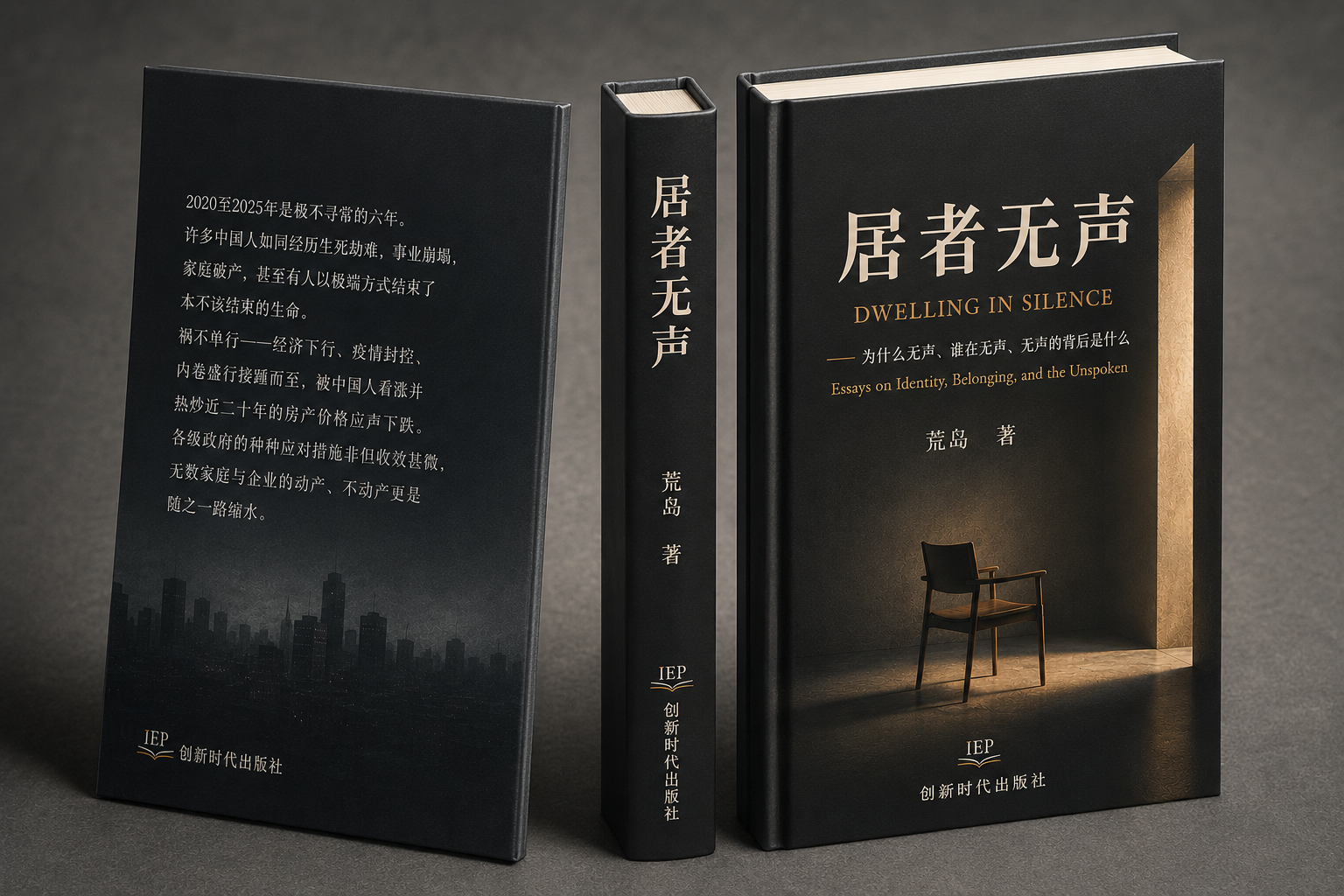
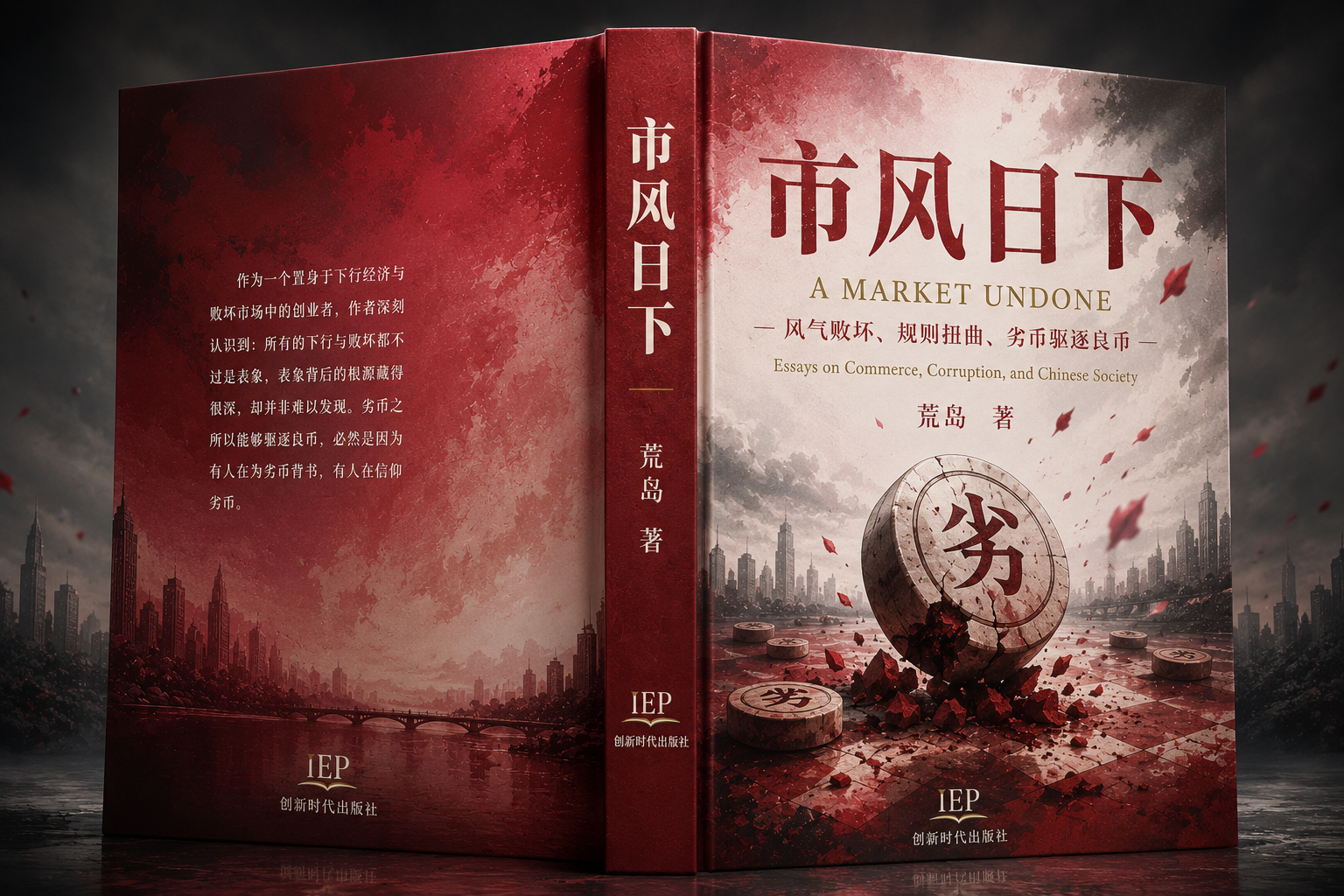
Innovation Era Press announces that A Market Undone, the latest work by author Desolate Isle, will be published in its Chinese edition in June. The book is described as follows:
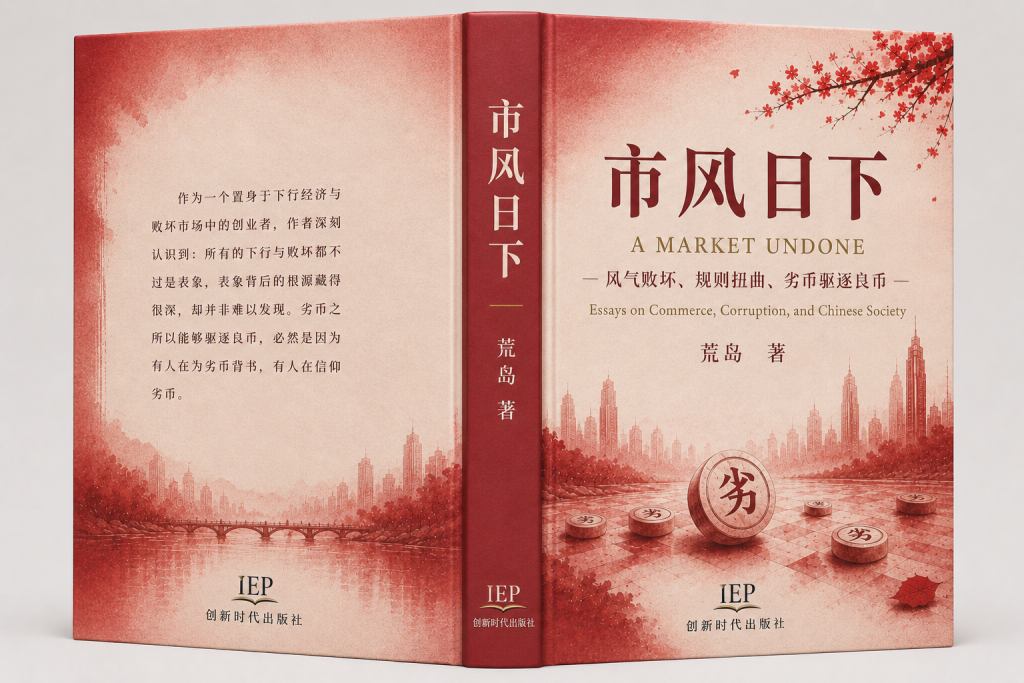
A Market Undone《市风日下》: Essays on Commerce, Corruption, and Chinese Society(风气败坏、规则扭曲、劣币驱逐良币) brings together 144 essays written by Gan Liu (pen name: Desolate Isle) over six years, from 2020 to 2025. The collection is organized around four thematic sections: “On Innovation,” “Voices of Entrepreneurship,” “Questions in the Impasse,” and “Perspectives on the Economy.”
Documentary realism, probing inquiry, absurdist observation, and sharp satire — these voices interweave throughout, together painting an unflinching portrait of an era defined by institutional constraint, economic deterioration, and the suppression of free expression. Every essay in this collection is drawn from the author’s own experience as an ordinary entrepreneur navigating a declining economy and a deteriorating market. In the spirit of the Chinese saying “a long illness makes the patient a doctor,” the book proceeds like a traditional Chinese medical examination — observing, listening, questioning, and probing — to offer a comprehensive diagnosis of China’s market paralysis, economic crisis, and the institutional pathologies that lie at their root.
This book speaks to anyone seeking to understand the economic and social realities of China between 2020 and 2025, and will be of particular value to scholars, analysts, and professionals engaged in Chinese studies, business research, and contemporary history.
The author writes: “Publishing this book leaves me with feelings both heavy and free. Heavy, because I find I have written so many pages documenting what has gone wrong. Free, because none of these essays will any longer be buried by rejection, deletion, or prohibition. They are all true accounts — and yet it is precisely their truth that made them dangerous, their honest narratives running counter to the hymns of praise that those in power required, rendering them sensitive, non-compliant, or even illegal. Through every setback and risk, I have persisted, and with the 170,000 words of this book, I hope to cast light on the many failures of China’s market economy, and to help more people see them clearly.”
As an entrepreneur who lived and worked inside a declining economy and a corrupted market, the author came to understand with painful clarity that all decline and corruption are symptoms — and that the roots behind those symptoms, however deeply buried, are not beyond discovery. When bad money drives out good, it is because someone is underwriting the bad, and someone is placing their faith in it.
It is the author’s hope that this book will find its place in the archive of history — that future readers, turning its pages, will come to know what that period of time was truly like. It is a work born of a particular era, yet it will not perish with that era. For truthful narratives have always outlasted the times that tried to silence them.