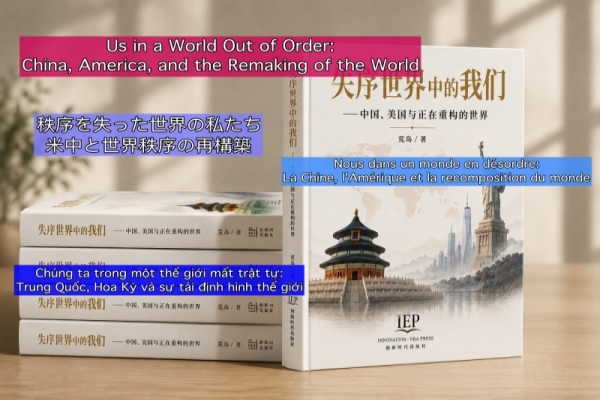
The multilingual editions of writer Isla Desolada’s (Huang Dao / 荒島) original Chinese work Us in a World Out of Order (《失序世界中的我们》) will be published under the following titles:
- English: Us in a World Out of Order: China, America, and the Remaking of the World
- French: Nous dans un monde en désordre : La Chine, l’Amérique et la recomposition du monde
- Japanese: 秩序を失った世界の私たち:米中と世界秩序の再構築
- Vietnamese: Chúng ta trong một thế giới mất trật tự: Trung Quốc, Hoa Kỳ và sự tái định hình thế giới

Meanwhile, following the release of the original Chinese work 我的2025:在一个失序的世界中生活 (《我的2025,活在一个失序的世界》) in North America and the United Kingdom in February 2026, the book is now being uniformly retitled Us in a World Out of Order — China, America, and the Remaking of the World. The simplified-Chinese e-book and hardcover editions, along with the traditional-Chinese e-book edition, are being published for worldwide release.
About the Book
This is not a prophecy, but a history unfolding in real time.
In 2025, the world appeared calm and prosperous on the surface, with impressive economic figures. Yet behind this placid dividend, the old system of rules had already fallen into structural imbalance. The author, “Isla Desolada,” was once a transportation expert in China, a columnist for central state media, and an entrepreneur who had published several books — until the drastic upheaval in the survival conditions of China’s private enterprises, together with a contraction in financial credit, plunged him into the mire of insolvency. In search of a way out, he was forced onto the path of exile.
In just thirty-five days of extreme, concentrated writing, the author distilled the shattering experiences of a year spent drifting through fifteen countries and regions — the United States, Japan, Canada, Mexico, Southeast Asia, and more. With a calm, objective, yet deeply humane pen, he chronicles his own transformations of identity: from an Uber driver living in an 8-square-meter shack in Los Angeles, to an inmate held in the “tin-foil room” of a U.S. immigration detention center, to a drifter searching for opportunity on the streets of Southeast Asia.
The core value of this work lies in its “microscopic” angle of observation. The author writes not only of his own twists of fate, but turns his lens toward the more than seventy individuals he met in this disordered age — among them the elderly couple, the Yangs, who failed to cross the border at Tijuana and faced deportation; the white-collar worker from Yunnan, resolute that he would “die in America even if it kills me”; the Sichuan boss who grew rich off gray-market business in Vietnam; and the Vietnam War veterans debating politics in a Pattaya café.
These fragmentary personal stories thread together, like clues, the cruelty of U.S. immigration policy, the grassroots pains of U.S.–China trade friction, the economic dynamics of Southeast Asia, and the anxieties both inside and outside China’s system. This is a powerful work of documentary nonfiction about survival, dignity, distrust of institutions, and the crossing of borders — one that captures, with precision, the true face of the world at the singular juncture that was 2025.