By Desolate Isle
A subtle but profound rupture is taking place in today’s global publishing landscape. For many authors who write in Simplified Chinese, this rupture is neither a technical problem nor merely a market problem. It is a structural predicament.
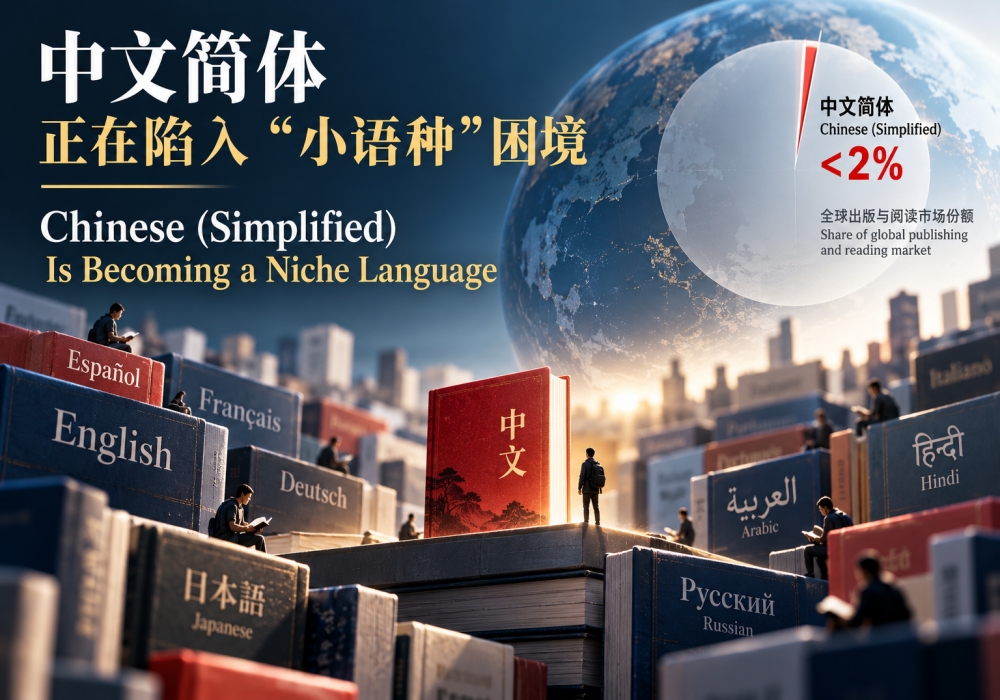
Take Amazon’s self-publishing system as an example. It offers an open door to almost every language, yet there is no path for uploading works written in Simplified Chinese. LinkedIn’s identity framework likewise offers no option that accommodates the Simplified Chinese context. Meanwhile, on platforms such as Medium and Substack, vast communities of English-language writers and paying readers thrive, forming a large, self-sustaining cultural ecosystem.
In many countries, publishing a book is no longer a barrier at all; it has become as routine as cooking a meal. Technology, channels and distribution are all in place, and the only real question an author faces is whether anyone will read the work. For Simplified Chinese literature, the question is far more complicated: whether a work should be allowed to exist and circulate at all, and that is not a decision the author gets to make.
Literature is, in essence, the most refined expression of a language. When a language is gradually pushed out of the systems of international exchange, the space for its literature contracts as well. Even with an enormous number of speakers, a language that lacks the capacity to travel across cultures can shrink in the global context and may slowly drift toward the margins.
Traditionally, lovers of literature have represented the intellectual height of a society. In China they are called wenren, the literati; across the wider world they are closer to what is meant by a scholar or a person of letters. Culture is supposed to flow through their exchanges, continually correcting and renewing itself, discarding the dross and keeping the essence. But as the walls between languages grow higher, that very exchange begins to falter.
The differences lie not only in language but in values and in the logic of storytelling.
In Chinese culture, marriage is often placed above love: marriage is right, and everything else is wrong. In the Western context, if love fades or disappears, there is no point in holding a marriage together. Much of a Chinese person’s life follows paths that have been quietly laid out in advance, with the answers already given. In European and American societies, choice and responsibility run through an entire lifetime; individuals must keep making decisions and bear the consequences.
Attitudes toward injustice differ just as sharply. Western societies emphasize the individual’s willingness to resist the system: if you tolerate injustice done to others, you will eventually become its victim yourself. In the Chinese context, injustice is often regarded as the misfortune of some other individual who happened to be harmed, with nothing to do with oneself. These differences profoundly shape how characters behave in literature and how their fates unfold.
Yet the Western world is not without fault. When Simplified Chinese literature struggles to enter its mainstream platforms, that in itself amounts to a form of cultural exclusion. Western readers may not understand the realities of the Chinese-language context. Many plotlines taken for granted in Western literature would have no room to unfold within the narrative structure of a Simplified Chinese work; the protagonist would not survive to the second or third episode, let alone reach a complete ending.
The novelist Yu Hua once recalled that before he became famous, a literary journal to which he had submitted a story asked him to change its ending so that it turned toward hope and goodness. The reason was simple: within a particular socialist narrative framework, characters were not supposed to meet with failure or tragedy. In order to be published, he made the change.
This is almost incomprehensible within the Western literary tradition. The value of a literary work lies in its truthful portrayal of life, not in serving the value orientation of some “system.” An ending should arise from the characters and from reality, not from external directives or standards.
It is precisely this gap that leaves Simplified Chinese literature surviving in a double bind. At home, it faces limits on what it may express; on international platforms, it struggles to be understood or accepted.
And so a question inevitably arises: to write, or not to write?
To keep writing may mean that a work never reaches a wide audience, becoming little more than a private conversation between the author and a handful of readers. Not to write means giving up expression, and expression is the very reason a writer exists.
The more practical path seems to be accommodation: building stories according to established rules so that they meet the expectations of censors or the market, and thereby win the right to be published. But is writing of that kind still true literature?
Who is right and who is wrong? That is a question for readers to answer. Among the literature lovers around the world whom I know, Chinese people who write in Simplified Chinese, there is a widespread sense that Simplified Chinese literature is sinking into the predicament described above. Of course, a language does not easily disappear, and literature does not stop growing. Those writers continue to create even while trapped in this bind.
The question is this: is such a predicament a passing phase, a dead end that one person will not live to see past, or a dead end that a society will never see past? Where is the new way out?